The pipe burst on a Tuesday. By Wednesday there were fans running in every room and a crew pulling up soaked flooring. By the following week the moisture readings came back clear, the equipment got loaded onto a truck, and everyone left.
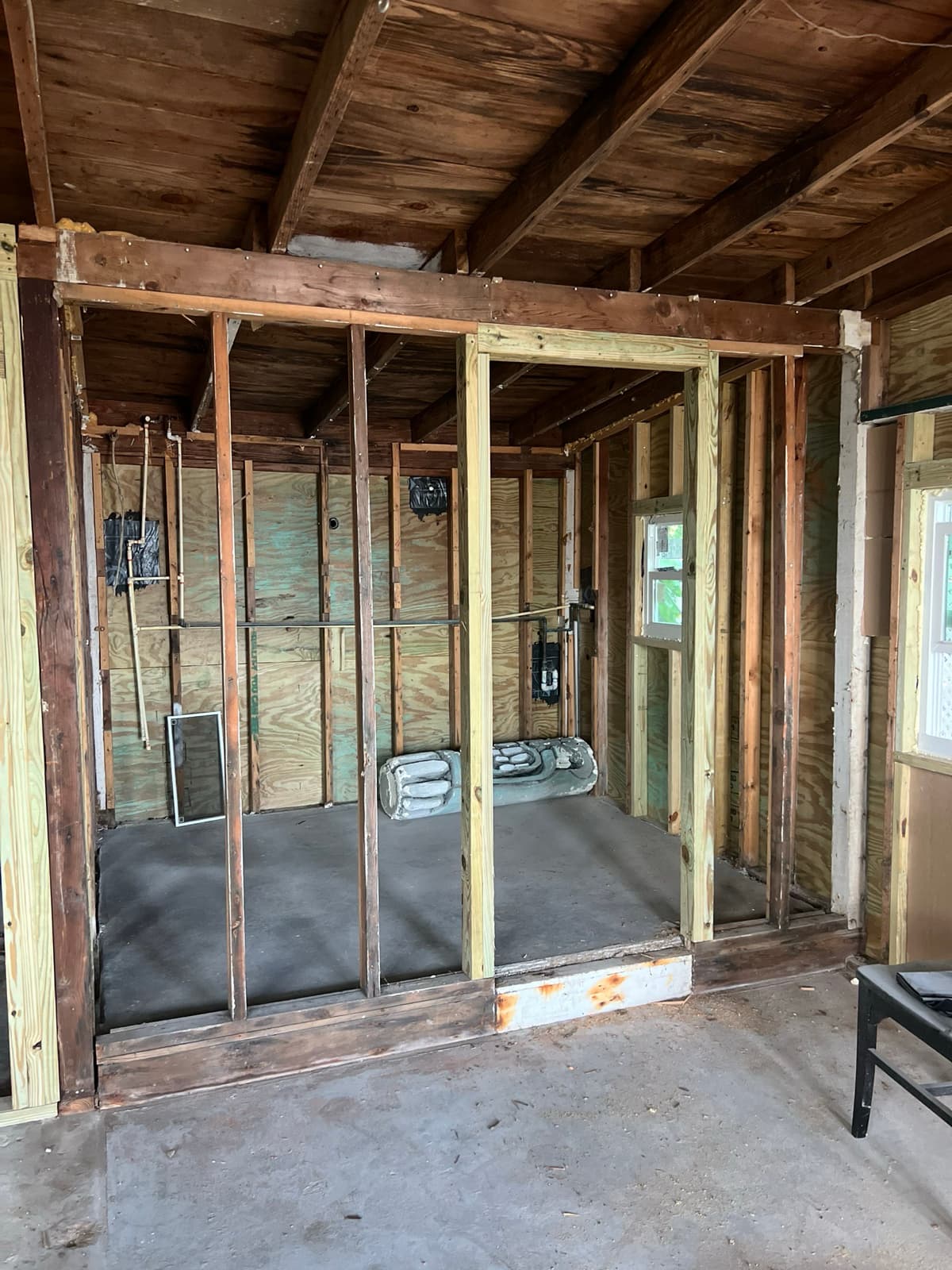
And the house is still torn apart.
Lower cabinets gone. Drywall cut two feet up the wall in a clean horizontal line. Subfloor exposed. Baseboards stacked in the garage. The kitchen does not work. The bathroom does not work.
This is the moment most Tampa homeowners discover something nobody explained to them upfront: the company that dried out the house is usually not the company that rebuilds it.
Two completely different jobs
Water damage response splits into two phases, and they are handled by different businesses with different licenses, different equipment, and different incentives.
Phase one is mitigation. Stop the water. Extract standing water. Remove saturated materials before mold takes hold. Run air movers and dehumidifiers until moisture content returns to normal. Apply antimicrobial treatment. Document everything for the insurance claim.
Mitigation is a fast, technical, equipment-heavy business. Good mitigation companies respond within hours, work around the clock, and are gone in a week.
Phase two is reconstruction. Rebuild what the mitigation crew removed. Hang and finish drywall. Replace subfloor. Install new flooring. Rebuild or replace cabinetry. Reconnect plumbing and electrical. Trim, paint, and finish the space back to livable.
Reconstruction is slow, coordinated, permit-driven general contracting work. It takes weeks or months, involves multiple licensed trades, and requires someone managing the whole sequence.
These are not the same skill set. They are not usually the same company.
Why the split exists
The reasons are structural, not accidental.
Licensing. Water mitigation in Florida does not require a general contractor license. Reconstruction does. A mitigation company can dry out a house without ever holding a GC license. The moment structural repair, cabinetry, plumbing reconnection, or electrical work enters the scope, a licensed general contractor has to be involved.
Speed versus sequence. Mitigation companies are built for emergency response. Their business model depends on mobilizing fast, working intensely for a short window, and moving to the next loss. Reconstruction runs on a completely different clock, with material lead times, permit reviews, inspections, and trade scheduling.
Insurance billing. Mitigation and reconstruction are typically billed as separate line items on a claim, often adjusted separately. Some carriers process them through entirely different channels.
Some larger firms do offer both under one roof. Many do not. The problem is that homeowners rarely find out which situation they are in until the drying equipment is already loaded on the truck.
Where homeowners get stuck
The gap between phases is where projects stall, and the stall is expensive.
Nobody owns the handoff. The mitigation company's scope ended. The insurance adjuster is waiting on a reconstruction estimate. The homeowner is expected to source a general contractor, get a quote, and submit it. Meanwhile the house sits open.
The reconstruction estimate does not match the mitigation scope. Mitigation crews cut drywall to a standard height and remove what tested wet. A rebuild contractor walking the same space may find framing damage, subfloor rot, or code issues that were not part of the original claim. That triggers a supplemental claim conversation that nobody warned the homeowner about.
Time pressure runs both directions. Florida's claim deadlines tightened significantly after the 2022 legislative reforms. Under current law, homeowners generally must notify their insurer of a new or reopened property claim within one year of the date of loss, and supplemental claims carry their own separate deadline. Many policies also contain prompt notice provisions requiring notification far sooner than the statutory outer limit. Waiting three months to find a rebuild contractor eats into a window that is shorter than most people realize.
The house is unlivable during the wait. Additional living expense coverage has limits. Every week spent searching for a contractor is a week of that coverage being consumed on hotel rooms rather than on the rebuild.
The insurance piece, honestly
A few things worth knowing, though every policy is different and homeowners should read their own declarations page carefully.
Notify the insurer immediately. Not after the water is cleaned up. Not after getting a contractor out to look. Florida's filing window runs from the date of loss, not the date of discovery, and policies frequently require notice within days.
Document before anything is removed. Photos and video of the damage in its original state, before mitigation begins, are the strongest documentation a claim can have. Once the wet drywall is in a dumpster, it cannot be re-photographed.
Understand the sudden versus gradual distinction. This single question drives more Florida water claim disputes than any other. A pipe that bursts is sudden and accidental. A supply line that has been weeping behind a wall for eight months is generally treated as a maintenance issue. Insurers scrutinize this heavily.
Move quickly on mold. Mold can begin growing on wet materials within 24 to 48 hours. Delays in mitigation do not just risk the structure, they can complicate the claim.
Get the reconstruction scope in writing early. The sooner a licensed contractor walks the property and produces a detailed estimate, the sooner the adjuster has something to work with and the sooner the rebuild can start.
For anything beyond general guidance, homeowners should talk directly to their carrier, and consult a licensed public adjuster or attorney if a claim is being denied or underpaid.
Permits are not optional on the rebuild
This trips up more Tampa Bay homeowners than almost anything else.
Mitigation generally does not require a permit. Reconstruction does. Replacing drywall, reinstalling cabinetry, reconnecting plumbing fixtures, and redoing electrical all fall under permitted work in Hillsborough, Pinellas, and Pasco counties.
Enforcement tightened noticeably across Tampa Bay after the 2024 storm season. St. Petersburg in particular now requires permits on repair work that homeowners historically handled quietly, including drywall, flooring, and finishes.
There is a second layer for properties in flood zones. If the cost of repair pushes past the substantial improvement threshold relative to the structure's depreciated value, the entire building may have to be brought into current flood code. That can mean elevation requirements and a dramatically expanded scope. A rebuild contractor who does not check flood zone status and run that calculation before starting is setting the homeowner up for a very bad surprise mid-project.
What to look for in a rebuild contractor
Not every general contractor is set up for insurance restoration work. A few things separate the ones who are.
A verifiable Florida general contractor license. Ask for the number and check it. Restoration work involves structural, plumbing, and electrical scope that requires proper licensing.
Experience writing estimates adjusters accept. Insurance reconstruction estimates follow specific formats and line-item conventions. A contractor who has never worked a claim will produce a document that slows the process down.
Willingness to walk the property before quoting. Anyone who quotes a water damage rebuild over the phone without seeing what is behind the walls is guessing.
Direct permit handling. The contractor should pull permits, schedule inspections, and manage county communication. Homeowners recovering from a loss should not be navigating the building department.
Clear scope on what happens if more damage is found. Reconstruction almost always uncovers something. The right contractor explains upfront how that gets documented, submitted as a supplemental, and handled in the schedule.
Why this matters more in Tampa Bay
Three local factors make the rebuild phase harder here than in most markets.
The housing stock is old. Large parts of Tampa and St. Petersburg were built between the 1920s and 1960s. Opening a wall in those homes frequently reveals galvanized supply lines, cast iron drains, outdated wiring, or framing that does not meet current standards. What began as a straightforward water loss becomes a scope conversation about code compliance.
Flood zones change the math. Substantial improvement rules apply to repair work, not just voluntary renovations. A significant water loss in an AE zone property can trigger compliance requirements that reshape the entire project.
Storm season compresses everything. After a major event, every contractor in the region is booked and every supplier is backordered. Homeowners who wait to line up reconstruction find themselves at the back of a very long queue.
The practical takeaway
If your house has water damage, ask one question early, before the mitigation crew finishes:
Who is rebuilding this, and when do they start?
If the mitigation company handles reconstruction, get that scope and timeline in writing. If they do not, start looking for a licensed general contractor while the fans are still running. Do not wait until the equipment is gone and the house is sitting open.
The homeowners who recover fastest are the ones who line up phase two before phase one ends.
How Quality Restoration & Renovations fits
Quality Restoration & Renovations is a licensed Florida general contractor, CGC1523357, and has handled reconstruction after fire, flood, and storm damage across Tampa Bay for over 25 years.
The team handles the rebuild phase: structural repair, drywall, flooring, cabinetry, plumbing and electrical reconnection, finish carpentry, and paint. All permits are pulled and all inspections are scheduled directly. Flood zone status and substantial improvement thresholds are checked as part of the initial walkthrough, before scope is finalized, so the compliance conversation happens upfront rather than mid-project.
If your home has water damage and you are trying to figure out the rebuild, reach out for a free consultation. The team will walk the property, review the mitigation scope, and provide a detailed written estimate. No obligation.