
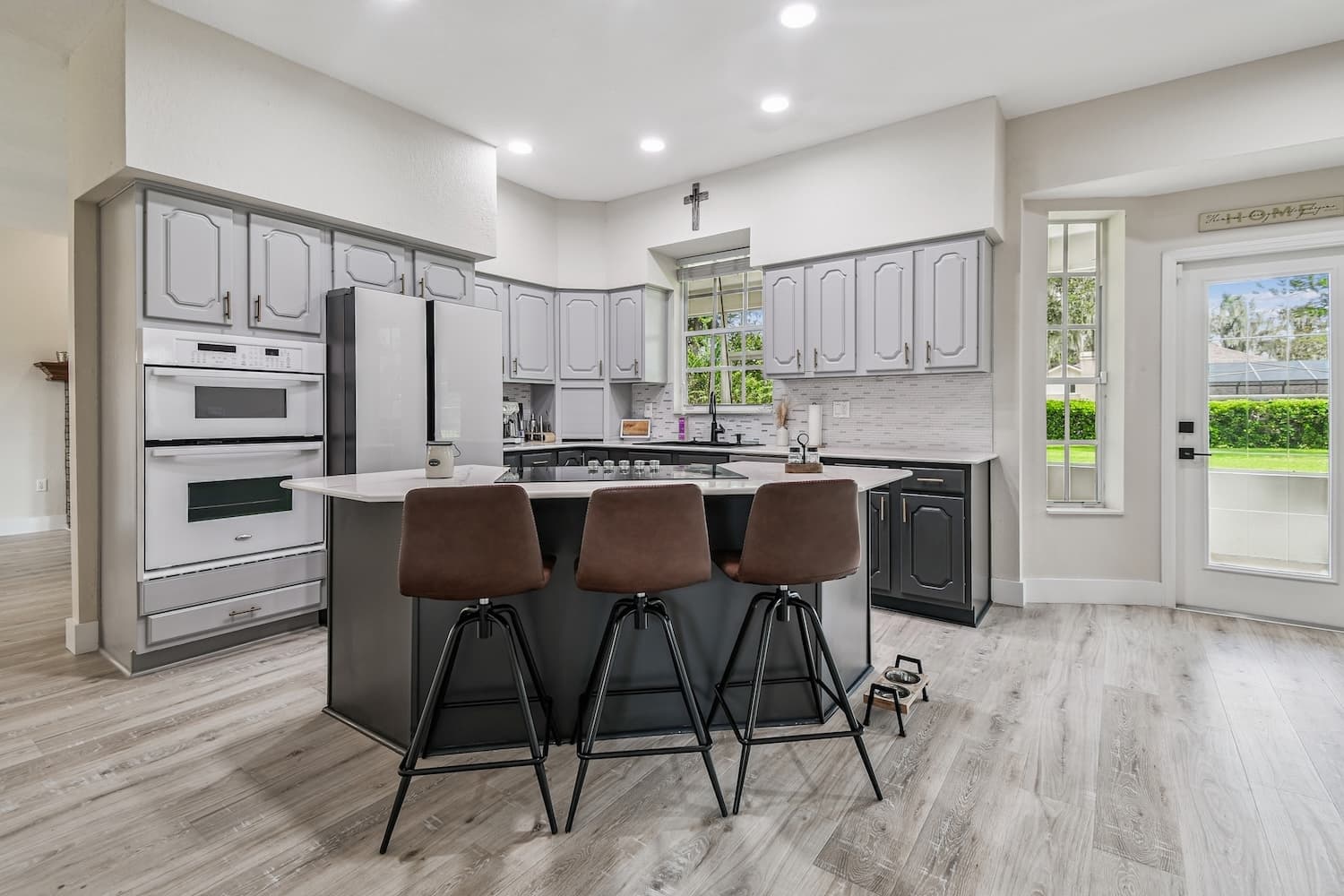
Ask ten Tampa contractors what a kitchen remodel costs and you will get ten different answers, most of them vague. The reason is understandable. A kitchen remodel is not one product with one price. It is a collection of decisions, and each decision moves the number.
That said, "it depends" is not a useful answer for a homeowner trying to figure out whether this project is even possible this year.
This is an honest breakdown of what kitchen renovations actually cost in Tampa Bay in 2026, where the money goes, and what makes the difference between a $28,000 kitchen and a $95,000 one.
The three tiers most Tampa kitchens fall into
Across the Tampa Bay market, kitchen projects tend to cluster into three ranges.
Cosmetic refresh: $15,000 to $30,000
Nothing structural changes. The footprint stays the same. Plumbing and electrical stay where they are.
What this typically includes: cabinet refacing or repainting, new hardware, new countertops, new backsplash, new sink and faucet, new flooring, and updated light fixtures.
This tier works well for kitchens that were built or renovated within the last fifteen to twenty years and are structurally sound but visually dated. If the cabinet boxes are solid and the layout works, refacing rather than replacing saves a significant amount.
Mid-range remodel: $30,000 to $60,000
This is where most Tampa homeowners land.
What this typically includes: full cabinet replacement with stock or semi-custom cabinetry, quartz or granite countertops, new appliances, new flooring, updated lighting including under-cabinet, new plumbing fixtures, and minor electrical updates to bring the space up to current code.
The layout usually stays close to the original, though small adjustments like relocating a dishwasher or adding an outlet run are common at this tier.
Full gut and high-end: $60,000 to $120,000 and up
The kitchen comes down to the studs. Walls may move. Plumbing and electrical get rerouted.
What this typically includes: custom or high-end semi-custom cabinetry, premium stone surfaces, professional-grade appliance packages, structural modifications, full electrical and plumbing rework, and finish carpentry throughout.
In Tampa's higher-value neighborhoods, full renovations frequently run well past $120,000. Waterfront and historic properties with structural complications can exceed $200,000.
Where the money actually goes
Homeowners are often surprised by how the budget distributes. Here is the general breakdown for a Tampa kitchen project.
Cabinetry: roughly 25 to 30 percent. This is consistently the single largest line item. The National Kitchen and Bath Association puts cabinetry near 29 percent of a typical kitchen budget. Moving from stock to semi-custom to fully custom cabinetry can swing a project by $10,000 to $20,000 on its own.
Labor: roughly 20 to 35 percent. This covers the general contractor plus every licensed sub-trade: plumbing, electrical, tile, carpentry, drywall, and paint. Skilled trade rates in the Tampa Bay area have climbed noticeably. Specialty work like plumbing relocations or structural modifications carries higher rates than standard installation work.
Countertops: roughly 10 percent. Quartz has become the practical default in Tampa for durability and consistency. Natural stone runs higher. Butcher block and laminate run lower.
Appliances: highly variable. A builder-grade package and a professional-grade package can differ by $20,000 or more. This is one of the few line items where homeowners have almost total control over the number.
Everything else: roughly 15 to 20 percent. Flooring, lighting, plumbing fixtures, drywall, paint, permits, and disposal.
What drives Tampa costs specifically
Several factors are pushing Tampa Bay renovation pricing in 2026, and they are worth understanding before setting a budget.
Skilled labor is tight. Florida's population growth has kept new construction and renovation demand high simultaneously. Skilled trades across the state are commanding meaningfully higher rates than they did before 2020, and Tampa is no exception.
Material costs stabilized but did not retreat. Cabinetry and countertop pricing came down from the 2021 through 2023 peaks, but pricing has settled above pre-pandemic levels rather than returning to them. Tariffs on certain imported materials have added pressure on specific product categories.
Tampa's housing stock is older than people assume. Hyde Park, Seminole Heights, and much of South Tampa have homes from the 1920s and 1930s. Opening a wall in one of those kitchens frequently reveals galvanized supply lines, cast iron drain stacks, knob-and-tube remnants, or framing that does not meet current structural standards. None of that shows up in an initial quote, but all of it has to be addressed.
Code compliance is not optional. Modern kitchen electrical requires GFCI protection, dedicated circuits for high-draw appliances, and proper grounding. Older Tampa kitchens rarely meet those standards. Bringing a kitchen up to current code is part of the scope, not an upsell.
Neighborhood matters more than square footage
Tampa is not one market. Renovation budgets vary substantially by neighborhood, driven by housing stock, buyer expectations, and structural complexity.
Davis Islands, Harbour Island, and waterfront South Tampa carry the highest budgets. Buyers in these areas expect premium finishes, and coastal construction requirements add cost. Full renovations here routinely start in six figures.
Hyde Park and Palma Ceia run high for a different reason. The homes are older and often historically significant. Structural updates, period-appropriate finishes, and historic district considerations all add scope.
Westchase, Carrollwood, and New Tampa sit in the middle. Housing stock from the 1990s and 2000s is generally sound, which means renovations focus on updating finishes rather than fixing infrastructure. Mid-range projects perform well here.
Brandon, Riverview, and the eastern suburbs tend toward the value end of the range. Newer construction means fewer surprises behind the walls.
There is a strategic note worth making here. In Tampa's premium neighborhoods, under-renovating a kitchen can actually hurt resale value. A basic cosmetic update in a Davis Islands home may not move the needle at all, because buyers in that market expect a different level of finish.
Layout changes are where budgets break
The single largest cost variable in most kitchen projects is whether walls move.
Keeping the existing footprint keeps plumbing, electrical, and structural work to a minimum. Moving a sink to an island means running supply and drain lines through the slab. Removing a wall between the kitchen and living room means structural analysis, potentially a load-bearing header, HVAC rerouting, electrical rerouting, and finishing work that extends into the adjacent room.
Open concept conversions in Tampa frequently push a project from the mid-range tier into the high-end tier on their own. The kitchen itself might be a $45,000 scope, but the wall removal, structural engineering, permitting, and expanded finish work can add $30,000 or more.
Adding an island to an existing layout typically adds $5,000 to $15,000, depending on whether the island needs plumbing, electrical, or both.
Permits, and why skipping them is a mistake
Any kitchen work in Hillsborough or Pinellas County that involves plumbing, electrical, or structural changes requires a permit. Most mid-range and full-gut renovations do.
Permit costs in Tampa generally run a few hundred dollars to just under a thousand depending on scope, plus Florida's state surcharge. That is a small fraction of a renovation budget.
If a contractor suggests skipping permits to save money, treat that as disqualifying. Unpermitted work creates problems at resale, complicates insurance claims, and can force expensive retroactive compliance if the county catches it. In Florida's current inspection environment, particularly after the 2024 storm season, enforcement has tightened considerably.
What most quotes leave out
Three things routinely surprise homeowners mid-project.
Demolition and disposal. Removing old cabinets, countertops, flooring, and fixtures takes labor and dumpster capacity. On a full gut, this is a real line item.
What is behind the walls. Water damage under a sink cabinet that nobody knew about. Wiring that does not meet code. Subfloor rot. A drain line that has to be replaced back to the main. These are common in Tampa homes built before 1980, and no contractor can quote them accurately before demolition begins.
Temporary kitchen logistics. A full kitchen renovation runs six to twelve weeks. Households have to eat during that time. Some homeowners set up a temporary prep area with a microwave and mini fridge in another room. Others budget for eating out. Either way, it is a real cost that belongs in the plan.
A contractor who addresses these upfront is being honest with you. A contractor whose quote comes in suspiciously low probably has not accounted for them.
Timeline expectations
Most Tampa kitchen renovations run four to twelve weeks from demolition to final walkthrough.
Cosmetic refreshes can finish in three to five weeks. Mid-range remodels typically run six to eight weeks. Full gut renovations with structural changes run ten to twelve weeks or longer.
Cabinet lead times are the most common cause of delay. Custom cabinetry can take eight to twelve weeks to arrive on its own, which is why ordering materials before demolition begins is standard practice on well-run projects.
How to think about return on investment
Kitchen renovations remain one of the strongest resale investments in the Tampa market, but the return is not linear.
Industry data consistently shows that focused minor kitchen remodels deliver a stronger percentage return than full gut renovations. A well-executed $28,000 refresh often recoups more of its cost at resale than a $95,000 rebuild, because the resale market rewards a kitchen that looks current more than it rewards one that is bespoke.
That said, resale value is not the only reason to renovate. Most Tampa homeowners renovating their kitchen are not selling next year. They are planning to live in the space. The right question is not only what the kitchen returns at resale, but what it is worth to use every day for the next decade.
Getting a real number for your kitchen
Every range in this article is a starting point. The actual number for any specific kitchen depends on the size of the space, the condition of what is behind the walls, the material selections, and whether the layout changes.
The only way to get a real number is a walkthrough. Quality Restoration & Renovations has been renovating kitchens across Tampa Bay for over 25 years, in everything from 1920s Hyde Park bungalows to new construction in Riverview. Recent work is in the project gallery. Every consultation starts with the home itself: what is there, what needs to change, and what the realistic budget looks like for the actual scope.
The team provides detailed written estimates after a free in-home consultation. Financing is available. No pressure, no obligation.
If you are planning a kitchen renovation in Tampa Bay and want a straight answer about what your specific project would cost, reach out for a free consultation. The first conversation is always about understanding the space and what it actually needs.