Tampa is not one residential market. Drive twenty minutes between Hyde Park and South Tampa and the housing stock, the neighborhood character, and the renovation challenges shift completely. Nowhere is this clearer than in bathroom renovation, where the work that hides behind the tile reveals more about a home than any finish choice ever could.
A contractor who handles Hyde Park bungalows the same way as South Tampa waterfront homes is going to produce mediocre work in both. The neighborhoods need different approaches because the homes themselves are different at every level: foundation, framing, plumbing, electrical, code, and aesthetic expectation.
This post breaks down the actual differences and what they mean for homeowners planning a bathroom renovation in either neighborhood.
The housing stock tells the whole story
Hyde Park was developed primarily between 1900 and 1930. The neighborhood is characterized by craftsman bungalows, foursquares, and a handful of larger colonial revival homes. Most original bathrooms were small, located on a single plumbing wall, and built with the technology available at the time: cast iron drain stacks, galvanized supply lines, lath-and-plaster walls, and wood subfloors.
South Tampa is a broader category that covers everything south of Kennedy Boulevard, but the renovation conversation usually centers on neighborhoods like Bayshore Beautiful, Davis Islands, Sunset Park, and Beach Park. The housing stock spans the 1940s through new construction, with a heavy concentration of mid-century homes and waterfront builds. Many of these homes have been renovated multiple times since original construction, layering era on era of plumbing and finishes.
These differences shape every meaningful decision in a bathroom renovation. Here is how.
Plumbing: the work nobody sees
In a Hyde Park bungalow, opening up a bathroom wall almost always reveals galvanized supply lines and cast iron drainage. Galvanized pipe corrodes from the inside over decades, restricting water flow and eventually leaking. Cast iron drain stacks last longer but suffer from joint deterioration and root intrusion at the building sewer.
The right approach in a Hyde Park bathroom renovation is to replace the supply lines entirely with modern PEX or copper, inspect and likely replace the cast iron drain runs back to a main connection, and bring the venting up to current code. None of this is optional if the bathroom is being torn out. Skipping these steps means a beautiful new bathroom built on top of plumbing that will fail in five to ten years.
South Tampa homes are a different story. Mid-century homes from the 1950s and 1960s typically have copper supply and cast iron drains, both of which can be in workable condition depending on maintenance history. Newer construction or recent full renovations may have PEX, PVC, or modern copper throughout. The renovation scope here is often less about replacing failing infrastructure and more about reconfiguring layouts: moving plumbing walls, adding fixtures, relocating vanities.
The cost implications are significant. A Hyde Park bathroom renovation almost always carries a higher plumbing budget than a South Tampa renovation of similar finish scope, because there is more existing infrastructure to remove and replace.
Framing and structure
Hyde Park bungalows were built with full-dimension lumber. The studs that look like 2x4s in a 1920s home are usually closer to 2x4 actual dimension, while modern 2x4s are 1.5x3.5 inches. The framing layouts also predate modern engineering: stud spacing varies, headers are undersized by current standards, and structural connections rely on heavy nailing rather than modern fasteners.
This matters for bathroom renovations in two ways. First, wall removals and openings require structural evaluation. The team often brings in a licensed structural engineer for any load-bearing changes in older Tampa homes, because the original framing tolerances do not match contemporary calculations. Second, blocking for vanities, grab bars, and shelving requires opening more wall than expected. Old framing rarely has blocking where modern bathroom hardware needs it.
South Tampa homes vary widely. Mid-century homes often have decent framing but may have settling issues, particularly in waterfront areas with sandy soils. Newer South Tampa homes use modern engineered lumber and standard framing layouts, making renovation scoping more predictable. Coastal homes also have hurricane-rated tie-downs and connections that need to be preserved or upgraded during any structural change.
Electrical and code
Older Hyde Park homes were originally wired with knob-and-tube electrical or early aluminum branch circuits. Most have been partially or fully rewired over the decades, but many bathrooms still have original wiring buried in walls. Modern code requires GFCI protection on bathroom outlets, AFCI protection on bathroom circuits, dedicated circuits for high-draw fixtures, and proper grounding throughout. A Hyde Park bathroom renovation typically requires significant electrical work to bring the room up to current code.
South Tampa homes have a wider electrical baseline. Mid-century homes may need significant upgrades. Recently renovated or newer homes may already meet current code or need only minor updates. The team always pulls the existing electrical permit history during initial consultation to understand what has and has not been touched.
Lighting layouts are also different. Hyde Park bathrooms tend to be smaller, with single overhead fixtures originally installed. Modern bathroom lighting design layers ambient, task, and accent lighting, which means new circuits, new switching, and often new boxes. South Tampa renovations more often involve updating or replacing existing modern lighting rather than adding it from scratch.
Code compliance and historic district considerations
Hyde Park sits inside the Hyde Park Historic District, which means exterior changes (windows, doors, siding, roofing) require architectural review board approval. Bathroom renovations are mostly interior work, so historic district review is not typically required for the bathroom itself. However, any window replacements or exterior venting changes (like a new bath fan exhaust) need to be designed in a way that respects the district guidelines.
The City of Tampa's permit process for Hyde Park renovations is generally straightforward, but the historic district review for exterior elements can add weeks to a project timeline. Planning around this is part of the scoping conversation, not an afterthought.
South Tampa has its own considerations. Waterfront properties in flood zones (Davis Islands, parts of Bayshore, Beach Park) trigger FEMA compliance review on substantial renovations. The team checks flood zone status as part of every South Tampa consultation, because a bathroom renovation that pushes a property over the 50% substantial improvement threshold can require the entire home to be brought into current flood code. This is unusual for bathroom-only renovations but happens more often than homeowners expect when combined with other recent work.
Aesthetic expectations
Beyond the technical differences, the two neighborhoods carry different design conventions.
Hyde Park bathroom renovations usually respect the home's character. That means preserving or matching original tile patterns, using period-appropriate fixtures (clawfoot tubs, pedestal sinks, subway tile), keeping color palettes neutral and timeless, and avoiding obvious era-marking choices that will look dated in a decade. The best Hyde Park bathroom renovations look like they could have been in the home for fifty years even when they are brand new.
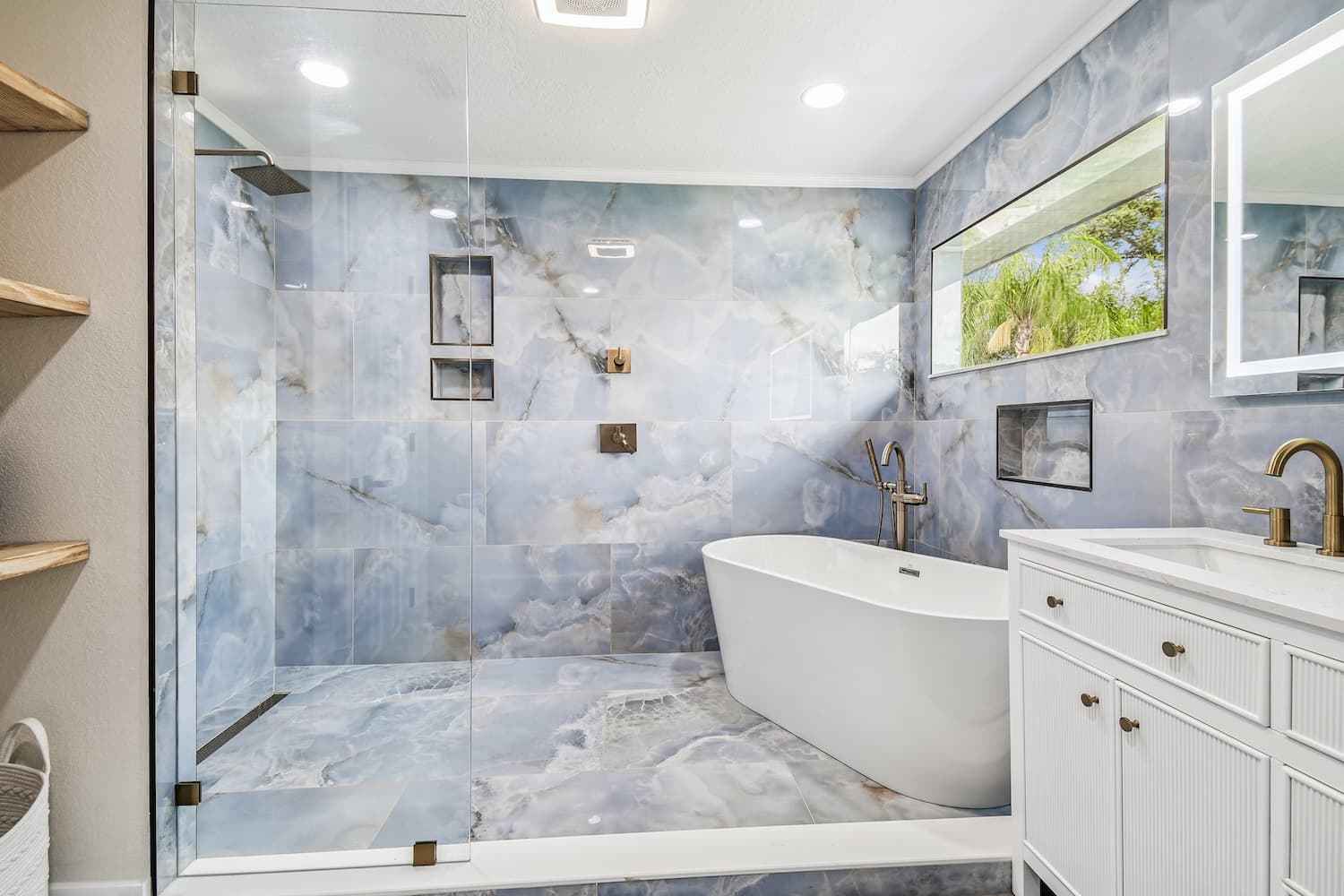
South Tampa, particularly the waterfront and luxury segments, leans toward contemporary design. Large showers, freestanding tubs, statement tile, brass or matte black fixtures, and integrated lighting are common. The aesthetic conversation is less about preservation and more about creating a spa-quality experience. Master suite renovations in South Tampa often expand the bathroom footprint significantly, taking square footage from adjacent closets or hallways.
Both approaches are valid. The mismatch happens when a contractor applies one neighborhood's design vocabulary to the other: a stark contemporary bathroom in a 1920s bungalow reads as wrong, while a vintage-feeling clawfoot tub treatment in a modern waterfront home feels misplaced.
What this means for the scoping conversation
When the team consults on a Hyde Park bathroom renovation, the conversation starts with infrastructure. What is the plumbing condition. What is the electrical baseline. What structural changes are required. What can be preserved from the original home. The finish discussion comes after the bones are understood.
When the team consults on a South Tampa bathroom renovation, the conversation often starts with the design vision. What kind of space is the homeowner trying to create. What is the budget tier. What are the layout options. Infrastructure questions come up, but they are less likely to be the determining factor in scope.
Neither approach is better. They are different because the work is different.
How to choose a contractor
A contractor who specializes in one neighborhood may be excellent there and weak elsewhere. A contractor who claims to handle both neighborhoods should be able to articulate, in detail, the differences described above. If a contractor cannot explain how a Hyde Park bathroom renovation differs from a South Tampa renovation, they are likely defaulting to a generic approach that will produce mediocre results in either context.
Quality Restoration & Renovations has handled bathroom renovations across both neighborhoods for over 25 years. The team brings the structural awareness and historic-respect approach that Hyde Park renovations require, alongside the design-build capability and code expertise that South Tampa projects demand. Every consultation starts with the home itself, not a template.
If you are planning a bathroom renovation in either neighborhood, the team is happy to walk the space, discuss the scope, and provide a free no-obligation consultation. The first conversation is always about understanding the home and what it actually needs.